by Kiflee bin Jimpi
edited by Nadzreeq Nor Majid
Every time we toss a plastic wrapper or leftover meal into the trash bin, a subtle illusion takes hold in our minds. We assume that once the lid slams shut, the lifecycle of our waste has officially ended. In reality, shoving waste out of sight is never the end of a problem, but rather the opening chapter of a massive environmental and financial crisis. In Malaysia, an average individual generates roughly 1.17 kilograms of solid waste every single day, causing huge towers of garbage to rise across landfills and swallowing hundreds of millions of tax dollars.
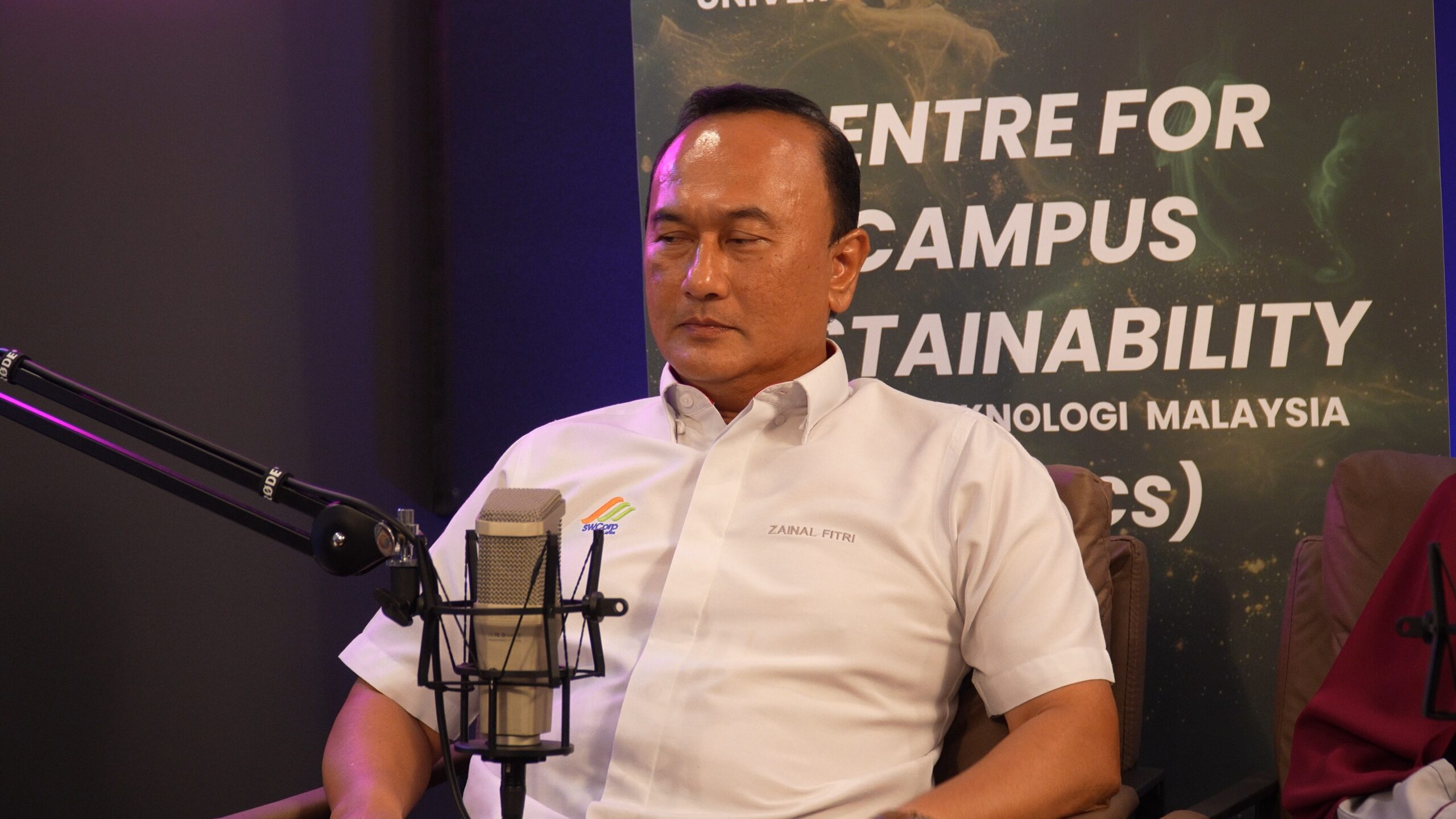
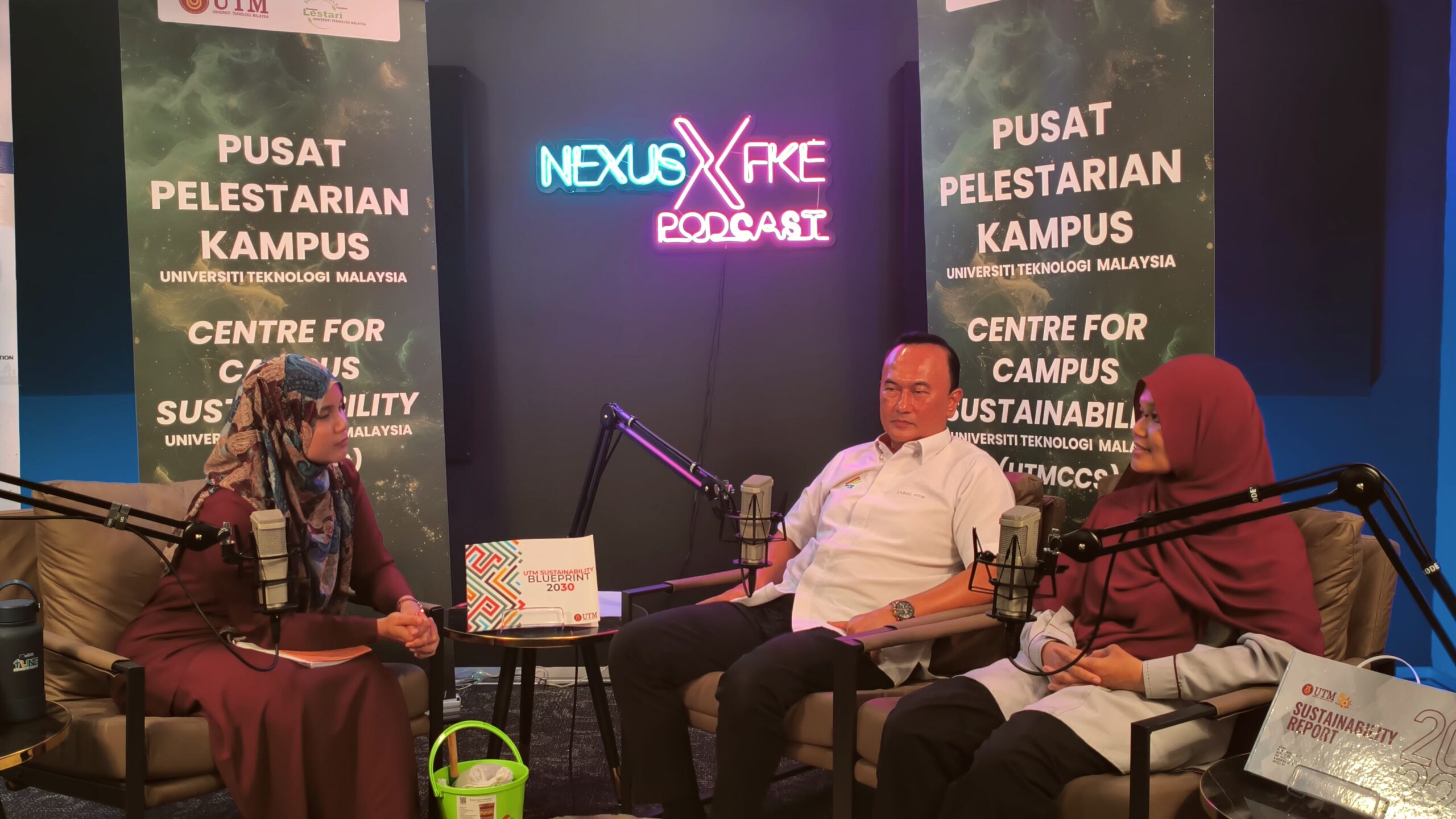
To explore whether a zero-waste future is a naive fantasy or an achievable reality, two leading figures joined the UTM Nexus podcast. Encik Zainal Fitri Haji Ahmad, Director of the Solid Waste and Public Cleansing Management Corporation (SWCorp) in Johor, sat down with Dr. Huzlina Hussein, a Senior Lecturer in Biosciences at Universiti Teknologi Malaysia (UTM) known as the “Compost Queen.” By combining strict policy enforcement with cutting-edge bioscience, they propose a radical paradigm shift for modern society. We must stop viewing discarded items as a burdensome negative and start recognizing them as a vital natural resource.
The journey of a single aluminum can or plastic bottle at a landfill site reveals a staggering environmental timeline. An aluminum can takes anywhere from 500 to 1,000 years to fully decompose, while a simple plastic bottle can persist for up to a million years. Synthetic materials do not simply vanish into thin air; they degrade into microscopic particles that seep into water tables, contaminate marine life, and eventually return to the dining plates in our own homes. Managing this endless tide requires expensive half-a-million-ringgit compactor trucks, constant labor costs, and heavy disposal fees, while landfills like Silong require mandatory 500-meter buffer zones that stall nearby housing developments.
Imagine instead if we viewed our waste management system as a continuously spinning bicycle wheel where every material moves in a closed loop. In nature, there is no such concept as useless trash, because every output becomes the biological foundation for new growth. This circular economic model is currently thriving at the Kenari Flats in Kangkar Pulai, a low-income housing community in Johor. Guided by experts, residents proved that everyday domestic waste can turn into tangible financial income, selling collected cooking oil for RM3.00 to RM3.50 per kilogram while repairing abandoned appliances and furniture for families in need.
One of the most pressing challenges in urban waste management is food waste, which accounts for nearly 50 percent of the total volume in household garbage bins. When organic leftovers rot uncontrollably inside tightly packed landfills, they emit dangerous greenhouse gases and generate toxic leachate liquid that pollutes underlying soil. To combat this widespread issue, UTM researchers teamed up with SWCorp Johor to develop an accessible home compost kit. This user-friendly kit allows everyday households to transform kitchen scraps into premium organic fertilizer without producing foul odors or attracting pests.
Building a home compost system can be easily pictured like assembling a delicious, multilayered sandwich. Users simply line the bottom of a container with dry leaves, followed by layers of soil, kitchen scraps, and a specially formulated microbial liquid called a compost booster. Fresh grass clippings naturally contain humic compounds that act like chemical handcuffs to firmly trap essential nutrients like Nitrogen, Phosphorus, and Potassium (NPK). Consequently, even when stored over extended periods, more than 90 percent of these vital nutrients remain trapped and ready to nourish garden plants and vegetables.
For apartment residents who lack spacious outdoor backyards, bioscience research offers a practical sun-drying alternative. Raw fruit peels and uncooked vegetable scraps can be dried under direct sunlight to stop mold growth before being ground into a fine organic powder. This nutrient-rich powder can be sprinkled directly into potted house plants without going through a long soil decomposition phase. Furthermore, 15 neighborhoods under Johor’s Taman Lestari Madani initiative are now equipped with non-electric community compost bins, empowering residents to process food waste on a larger scale and generate free fertilizer for local gardens.
The real-world impact of UTM’s translational research extends far beyond kitchen scraps and garden beds. Through multidisciplinary collaborations with local non-governmental organizations, university scientists are upcycling discarded mussel and cockle shells into high-value ceramic items and water filtration systems. Additionally, unrecyclable glass waste that commercial factories normally reject is crushed using specialized machinery into smooth, non-sharp sand grains. This upcycled glass sand is then transformed into commercial handicrafts and green building materials, proving that scientific innovation can turn low-value trash into prestigious commercial products.
Alongside community education and scientific breakthroughs, strict legal enforcement serves as an indispensable pillar for lasting social change. Under Act 672, which governs solid waste management across seven states, throwing litter in public areas or tossing trash from car windows carries serious legal consequences. Violators are summoned directly to court, facing maximum fines of RM2,000, potential prison terms, and mandatory community service orders for up to 12 hours to clean public drains, sweep streets, and sanitize public restrooms. Automatic arrest warrants are issued for individuals who fail to appear, ensuring that those who dirty the environment take direct responsibility for restoring it.
These firm regulatory measures directly align with the Johor State Government’s Economic Transformation Plan and the Maju Johor 2030 vision to build a clean, sustainable, and economically vibrant region. However, modern infrastructure and updated laws will never achieve true success without a personal shift in public mindset. Sustainable habits often fail to take root because individuals feel their isolated actions are too small to make a meaningful difference against global pollution.
This hesitation is best answered by the classic story of a forest fire and a persistent little hummingbird. The tiny bird flies back and forth, carrying a single drop of water in its small beak to douse a raging forest fire while other animals watch in doubt. On its own, one drop seems utterly insignificant, but if 30 million birds perform the exact same action at once, their combined water drops can extinguish the mightiest flames. Managing waste follows the exact same truth: separating a single plastic bottle or composting household food scraps may seem small, but when practiced consistently by millions of citizens, it will safeguard our planet for future generations.