by Assoc. Prof. Dr. Norma Alias
Edited by Dr. Azlin Abd Jamil
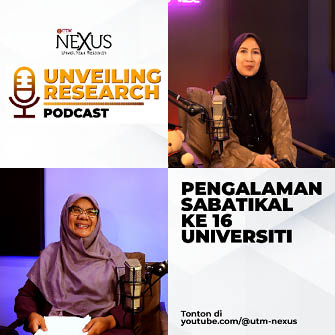
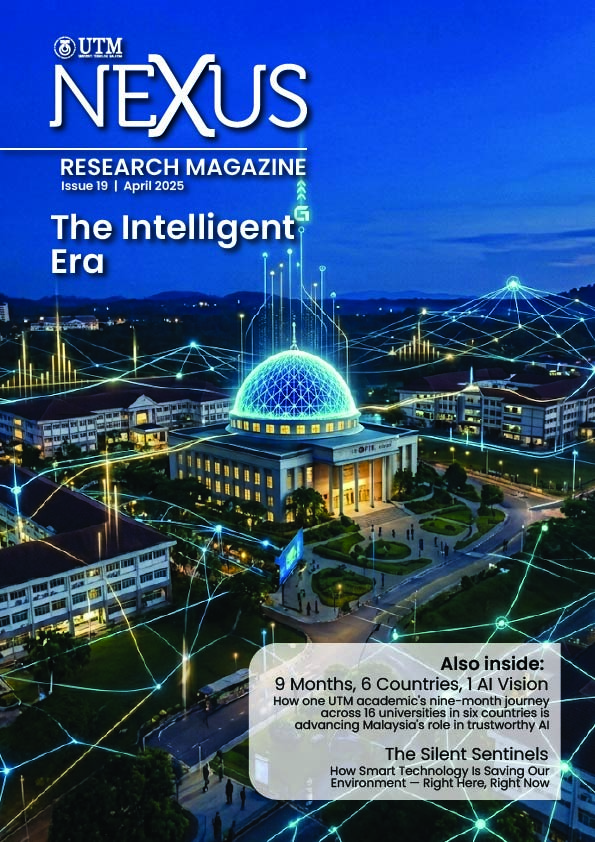
In April 2025, Associate Professor Dr. Norma Alias of Universiti Teknologi Malaysia (UTM) embarked on what was intended to be a structured academic sabbatical. With a clear itinerary, planned institutional visits, and defined targets in research, innovation, and collaboration, the journey was already ambitious. But by December 2025, it had evolved into something far greater: a powerful demonstration of how UTM scholarship can shape conversations on artificial intelligence (AI) across borders.
Over n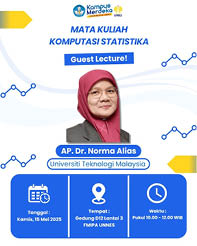 ine months, Dr. Norma engaged with 16 universities across six countries, India, Indonesia, Saudi Arabia, China, Pakistan, and Malaysia, not simply as a visiting academic, but as a keynote speaker, research collaborator, trainer, and strategic knowledge partner. Her journey highlighted a compelling truth: Malaysia is not merely following global AI developments. Through scholars like Dr. Norma, it is helping to define them.
A Sabbatical That Became a Movement
The sabbatical began with careful preparation. Dr. Norma had already established valuable networks through previous collaborations, including formal partnerships with institutions such as Chandigarh University in India and King Saud University in Saudi Arabia, as well as engagements with Indonesia’s National Research and Innovation Agency (BRIN). Her first destination, Chandigarh University’s 14th International Faculty Exchange Program, was part of that strategic plan.
Yet once the journey began, momentum took over. Each lecture, workshop, and conference opened the door to the next. A keynote at the International Conference on Advancements in Mathematics led to invitations from KL University and MJCET in Hyderabad. These engagements then expanded into new collaborations, including a keynote at the IEEE International Conference on EarthSense 2025 and subsequent research discussions on environmental monitoring. In Pakistan, invitations multiplied rapidly, bringing her to institutions such as Rawalpindi Women University, Government College Women University Faisalabad, Bahauddin Zakariya University, and the renowned Abdus Salam School of Mathematical Sciences.
What emerged was more than a sabbatical, it became a dynamic “hub-and-spoke” model of academic influence, where expertise generated trust, and trust generated opportunity.
Championing Trustworthy AI Through Mathematical Rigor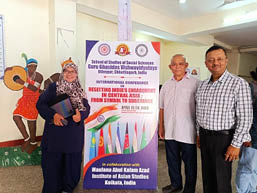
At a time when AI is often discussed in headlines and hype, Dr. Norma brought a more grounded and essential perspective: the future of AI depends on mathematical rigor.
Her work centres on Topological Data Analysis (TDA), an advanced mathematical approach that helps uncover the deeper structure and “shape” of complex data. While conventional AI often focuses on pattern recognition, TDA allows researchers to understand relationships, connections, and hidden structures that make AI systems more robust, explainable, and trustworthy.
This emphasis on trustworthy AI was not theoretical. It translated into real, high-impact research outcomes during the sabbatical.
In India, collaborations at KL University and MJCET contributed to a CNN-Geodesic Active Contour model for deforestation monitoring, analysing 38 years of satellite imagery in the Iskandar Puteri region of Johor. The model reportedly achieved 96.4% accuracy and processed data 847 times faster than conventional methods, demonstrating how advanced AI can support sustainability, policy monitoring, and environmental governance.
At King Saud University, Dr. Norma co-developed the Adaptive Network Anomaly Detector (ANAD), a real-time cybersecurity system using hybrid AI to detect network threats. The collaboration also resulted in intellectual property recognition where UTM retained 90% ownership, reinforcing UTM’s leadership in high-value, internationally recognised research.
 From Research Labs to Real Communities
One of the most compelling aspects of Dr. Norma’s sabbatical was its direct connection to society.
At BRIN in Indonesia, she contributed to an Offline-First Advanced Dynamic Multi-Hazard Mapping System, designed to continue functioning even when internet connectivity fails. Using Edge AI, the system can detect hazards and trigger evacuation alerts in under five seconds, an innovation with life-saving implications for disaster-prone communities.
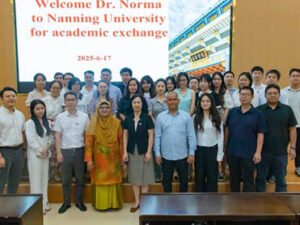
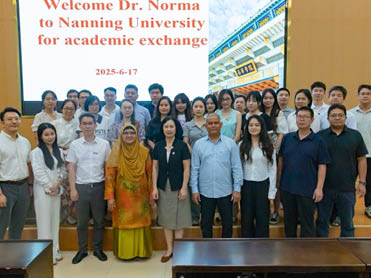
In China, her workshop at Nanning University focused on helping small and medium enterprises (SMEs) understand how AI can be used through accessible, no-code platforms. This was not AI as an abstract concept, but AI as a practical enabler for everyday business competitiveness.
In Pakistan and Indonesia, faculty members and researchers gained exposure to Large Language Models (LLMs) for research productivity, while students encountered a new vision of how mathematics and AI could be used to solve national challenges. In one particularly moving moment, a student reportedly told Dr. Norma after her keynote: “I didn’t know mathematics could do this.” That encounter, she reflected, represented an impact beyond publications or KPIsit was about awakening possibility. The industry connection between TnT Industry, PIP Group, and Bahauddin Zakariya University has been mentored and is still growing. For students and professors involved, this partnership involves mentorship support to promote development, information sharing, and hands-on industry exposure.
A Global Perspective on AI, and Malaysia’s Place in It
Across six countries, Dr. Norma observed different strengths in national AI ecosystems. Saudi Arabia offered strong infrastructure and strategic alignment under Vision 2030. India demonstrated scale, patent culture, and entrepreneurial energy. Indonesia showed how AI can be grounded in local culture and community relevance. China emphasised commercial application and industry adoption. Pakistan, despite resource constraints, displayed extraordinary intellectual hunger and commitment.
And Malaysia?
Her experience suggests that Malaysia, particularly through UTM, is well positioned to lead in a distinctive and valuable niche: trustworthy AI that is mathematically sound, explainable, ethically grounded, and socially relevant. Throughout the sabbatical, Dr. Norma was consistently invited as the expert, not merely as an observer. She brought Malaysian perspectives, UTM methodologies, and the spirit of national ambition into international academic spaces.
This matters because in the global race for AI leadership, not every country must compete in the same way. Malaysia can lead where trust, validation, interdisciplinary rigor, and meaningful application matter most via Malaysia’s AI Nation 2030.
From Individual Success to Institutional Opportunity
Dr. Norma’s sabbatical is more than a personal milestone; it is a model for institutional transformation.
Her experience points to the value of a stronger UTM framework for global academic mobility, strategic sabbatical planning, and post-sabbatical impact scaling. A formal Global Academic Fellowship or dedicated seed funding for sabbatical-generated collaborations could help turn individual international engagements into sustained institutional partnerships. Knowledge assets such as training modules, proposals, and collaboration frameworks could also be systematically archived and shared across faculties to multiply impact.
More importantly, her journey reinforces a larger message: when UTM invests in academic excellence, the returns are not confined to campus. They ripple outward to international partners, industries, communities, and future generations of scholars.
Knowledge Shared, Impact Multiplied
At its core, this story is about more than travel, conferences, or international visits. It is about what happens when expertise is carried with purpose.
Dr. Norma’s nine-month sabbatical demonstrates how a UTM academic can move from campus to the global stage while remaining deeply rooted in values that matter: knowledge sharing, scientific rigor, human impact, and service to society. It serves as a reminder that the intelligent era has already arrived and is being shaped by UTM through AI, XAI, and multi-agent AI.
As Malaysia continues to strengthen its place in the global knowledge economy, stories like this show the way forward: bold scholarship, meaningful partnerships, and a commitment to ensuring that innovation serves not only technology, but people.
Knowledge, after all, shines brightest when it is shared.