As businesses accelerate their sustainability and Net Zero commitments, carbon accounting is becoming an essential part of strategic business management. The ability to accurately measure, manage and report greenhouse gas (GHG) emissions enables organisations to make better decisions, reduce risks and identify opportunities for greater efficiency.
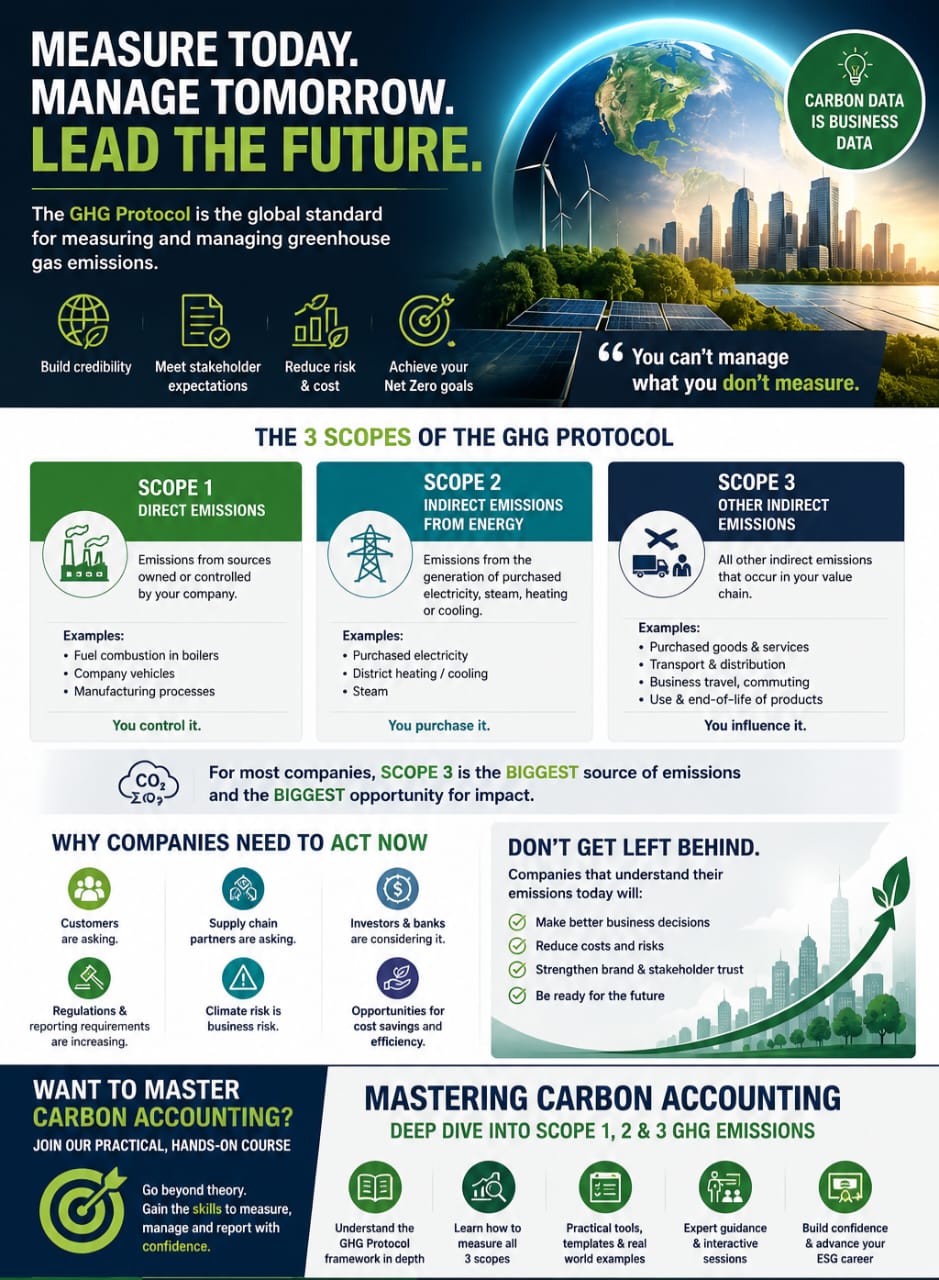
The GHG Protocol provides a globally recognised framework for measuring and managing greenhouse gas emissions through three key emission categories:
Understanding the 3 Scopes
Scope 1 – Direct Emissions
These are emissions from sources owned or controlled by an organisation, such as fuel combustion in boilers, company vehicles and manufacturing processes.
Scope 2 – Indirect Energy Emissions
These emissions arise from the generation of purchased energy, including electricity, steam, heating and cooling.
Scope 3 – Other Indirect Emissions
Scope 3 covers emissions across the organisation’s wider value chain, including purchased goods and services, transportation and distribution, business travel, commuting, and the use and end-of-life treatment of products.
For many organisations, Scope 3 represents the largest share of their carbon footprint—and therefore one of the biggest opportunities for meaningful emissions reduction.
Why Businesses Need to Act Now
The pressure to understand and disclose carbon emissions is increasing. Customers, supply-chain partners, investors and financial institutions are paying greater attention to corporate climate performance, while regulations and reporting requirements continue to evolve.
At the same time, climate risk is increasingly recognised as a business risk. Effective carbon accounting can help organisations:
- Make better-informed business decisions
- Identify opportunities to reduce costs and improve efficiency
- Manage climate-related risks
- Strengthen stakeholder confidence and corporate reputation
- Prepare for evolving sustainability requirements
- Support long-term Net Zero and decarbonisation strategies
From Measurement to Action
Carbon data is increasingly becoming business data. Organisations cannot effectively manage what they cannot measure.
Mastering carbon accounting therefore goes beyond simply calculating emissions. It requires organisations to understand the GHG Protocol framework, collect reliable data across Scopes 1, 2 and 3, apply practical accounting methods, and translate emissions information into actionable decarbonisation strategies.
For professionals seeking to strengthen their capabilities, we are pleased to invite you to an upcoming training programme:
📢 Training Invitation: GHG Inventory, Accounting & Reporting for Energy Sector
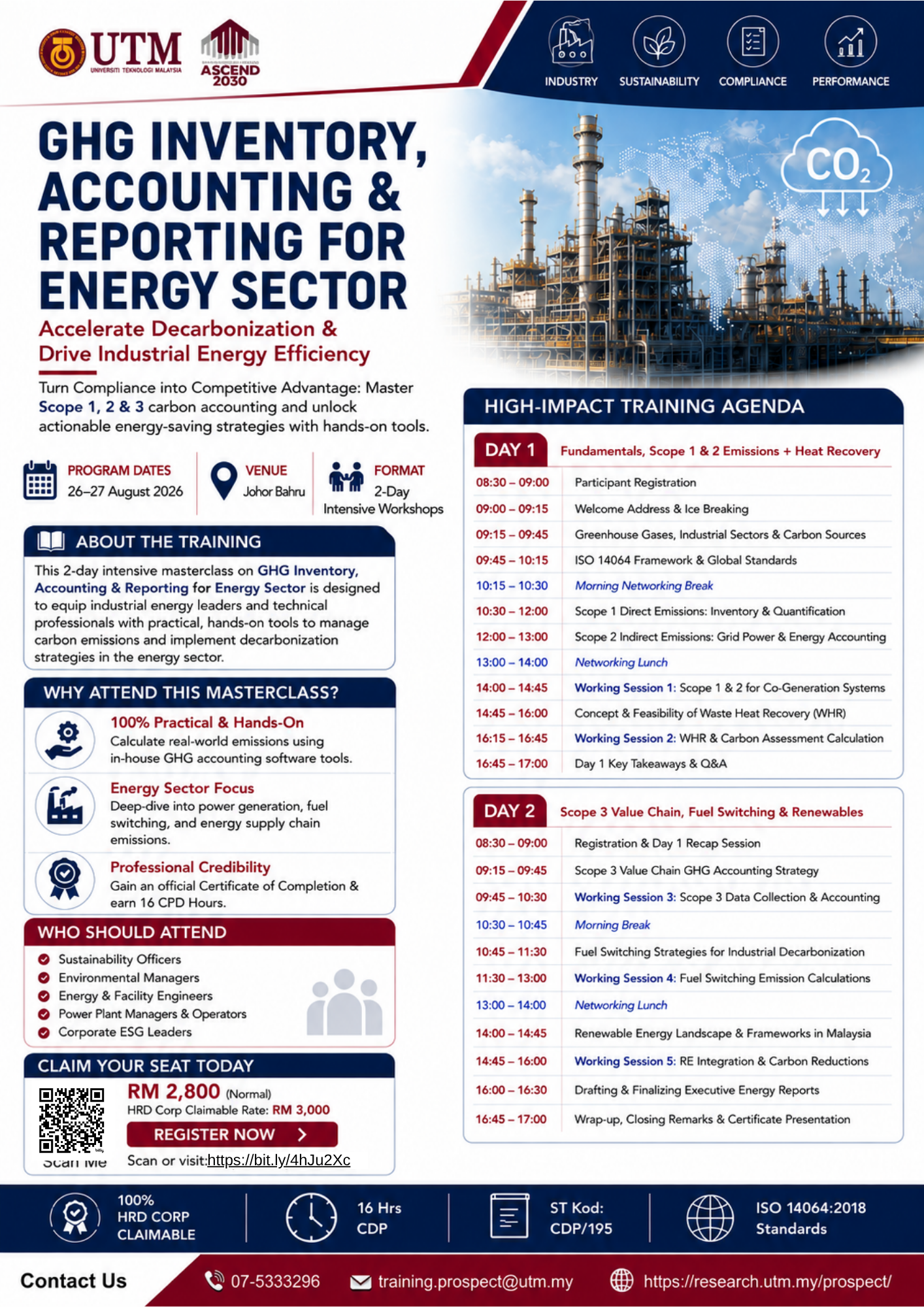
The Process Systems Engineering Centre (PROSPECT), Universiti Teknologi Malaysia (UTM) is organising a 2-day intensive professional training designed to equip participants with practical skills in carbon accounting and emissions management.
📅 Date: 26–27 August 2026
📍 Venue: Johor Bahru
🎓 CPD: 16 Hours
📜 ST Kod: CDP/195
🌐 Framework: ISO 14064:2018 Standards
What You Will Learn
- GHG Inventory, Accounting & Reporting fundamentals
- Scope 1, 2 & 3 emissions accounting
- ISO 14064 framework and global standards
- GHG data collection and quantification
- Co-generation systems and waste heat recovery
- Fuel switching and emission reduction strategies
- Renewable energy integration
- Practical GHG accounting tools and exercises
Who Should Attend?
- Sustainability & ESG professionals
- Energy and facility engineers
- Environmental managers
- Power plant operators and managers
- Corporate decarbonisation teams
💰 Fee: RM2,800 (Normal) | HRD Corp Claimable: RM3,000
📞 07-533 3296
📧 training.prospect@utm.my
🌐 https://research.utm.my/prospect/
This training provides the practical foundation needed to move from carbon awareness to real-world emissions management and decarbonisation action.
Measure today. Manage tomorrow. Lead the future.
#GHGAccounting #GHGProtocol #CarbonAccounting #Scope1 #Scope2 #Scope3 #NetZero #Decarbonisation #ESG #Sustainability #ClimateAction

